Labubu Marketing Lessons for CPG: What Transfers, What Won’t
You Can’t Manufacture Labubu’s Scarcity, but You Can Steal Why It Sells
The Labubu frenzy is deflating right on schedule. What’s left standing is the lesson actually worth stealing, and it transfers to a $6 product on a grocery shelf.
Last November, grown adults camped outside Starbucks before sunrise for a $30 cold cup shaped like a teddy bear. It sold out in hours. By the afternoon, resale listings hit $300 and up, and stores were rationing one per customer. A coffee chain had just run the Labubu playbook: manufactured scarcity, a collectible object, a resale frenzy. It worked exactly the same way.
Somewhere in your last planning cycle, a slide probably appeared with some version of “what can we learn from Labubu?” It’s a fair question. The popular answer (blind boxes and manufactured scarcity) is the wrong one. It already stopped working for the brand that invented it.
Pop Mart sold roughly 100 million Labubu units in 2025. Then it scaled production about tenfold, and the scarcity engine did what scarcity engines always do when supply catches up: resale prices on many models fell by half or more, some slipped below retail, and global search interest has been sliding since last summer. The spike is ending. What’s left underneath is the part worth studying, and the part a CPG brand can actually use.
(A quick frame before we go on: whether your brand owns a clear territory in buyers’ minds is Dimension S5 (Category Definition) in our 29-point brand audit. Scoring yours takes 8 minutes: audit.tracebrandbuilding.com.)
TL;DR
Labubu’s mania ran on mechanics CPG can’t copy: blind-box odds, manufactured scarcity, resale speculation. They’re already deflating. Prices crashed once production scaled.
What survives the crash is the real engine: buying a Labubu meant joining an identity. Belonging is buildable in any category, including yours.
Below: what actually transfers, the tote-bag test, and how everyday brands build membership without a single blind box.
The mechanics behind the Labubu craze, and why they broke
Be honest about what powered it. Blind boxes run variable-reward odds, the same intermittent-reinforcement loop a slot machine uses. Limited drops manufacture scarcity. A liquid resale market turns each figure into a lottery ticket with a secondary price. Hype does the rest. Every piece of it is engineering, and brilliant engineering at that.
It’s also unavailable to you. A $6 product bought weekly can’t hide itself in a mystery box. Your retail partners want forecastable velocity; engineered stockouts buy you a category review conversation nobody enjoys. And a granola bar will never carry a resale premium. The mechanics that built the spike don’t transfer to repeat-purchase categories, and chasing them produces gimmick campaigns that read as desperation.
Here’s the part the “be more like Labubu” slide misses: the mechanics have already turned on their inventor. Scarcity only prices demand; it doesn’t create it. The moment Pop Mart turned up the factories, the premium evaporated. Demand built on the odds of getting one is a spike with a built-in collapse. Demand built on belonging is the curve that holds after the hype dies.
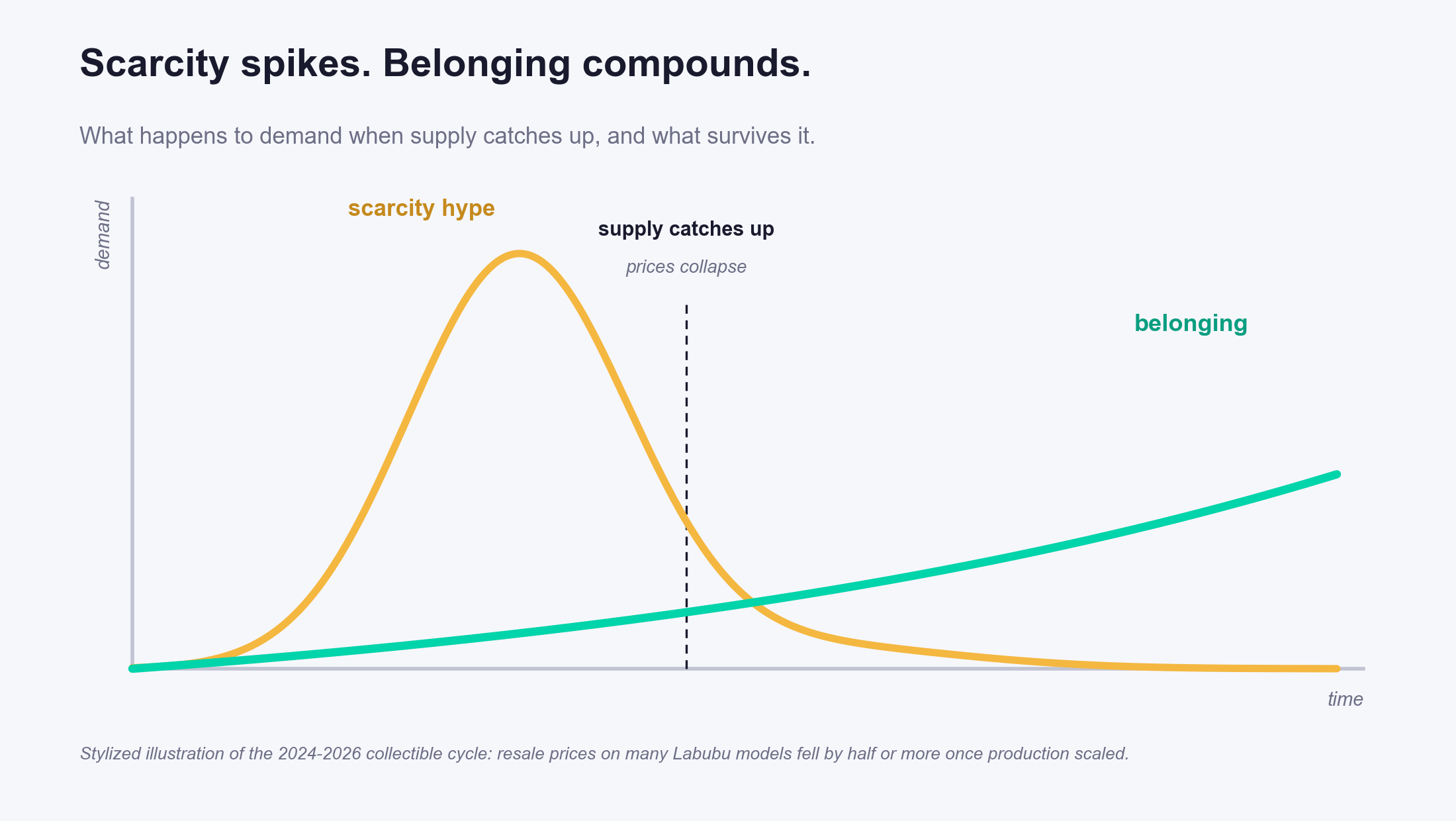
When supply catches up, only belonging keeps compounding.
What Labubu actually sells: membership
Watch what buyers do after the box opens: the figure clips onto a handbag and goes out in public, where strangers who get it recognize a fellow member. Everyone else just sees a toy. Consumer researchers Albert Muniz and Thomas O’Guinn gave it a name back in 2001. They called it a brand community, a structured web of social relationships among admirers of a brand. The toy is the membership card.
The same wiring powered the Bearista morning. Nobody needs a bear-shaped cup. People wanted to be seen as the kind of person who has one. Starbucks could run the play because decades of identity were already in the bank. The cup cashed it out.
This is the transferable part. Scarcity set the membership’s price. The membership itself exists because the object says something its owner wants said about themselves. Strip away the gambling mechanics and that engine still runs quietly, in categories as boring as water, totes, and tumblers.
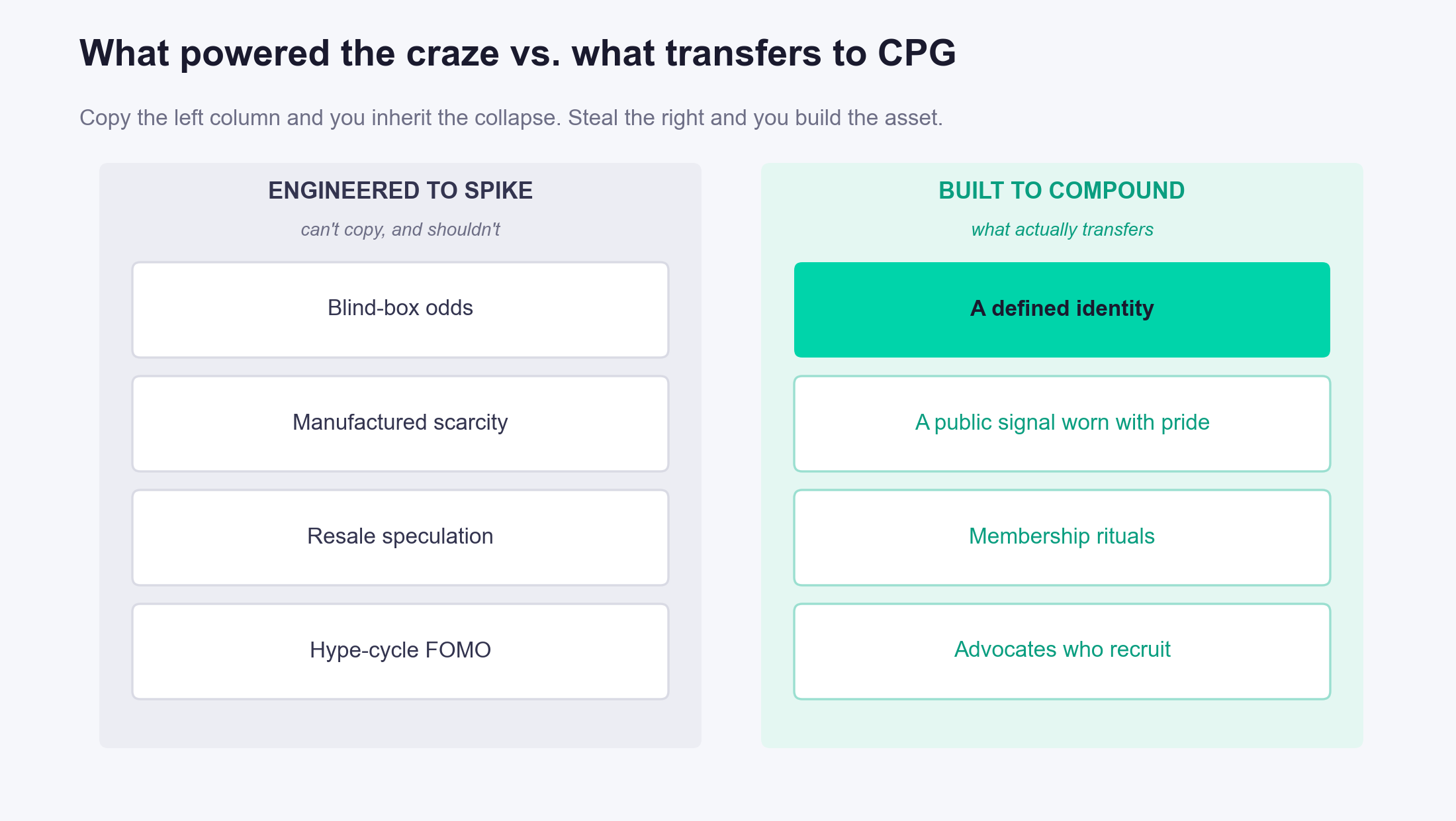
Copy the left column and you inherit the collapse. Steal the right and you build the asset.
The tote-bag test: would anyone display your brand?
Everyday proof already exists at CPG price points. Shoppers collect and resell Trader Joe’s canvas totes, treating a grocery bag as a statement piece. Liquid Death sells water in a category with near-zero involvement, yet fans buy its merch and some tattoo its logo. Stanley turned a steel cup into a colorway to be collected and displayed. You’ve seen these three in every brand deck since 2024. That’s the tell. The list of everyday brands that pass barely fills a slide. Different categories, one mechanism: the brand stands for something specific enough that carrying it says something.
So run the test on your own brand. What would someone be signaling if they carried your tote? Skip “they like our product.” What would it say about them? If the honest answer is nothing, you don’t have a belonging problem. You have an identity problem. A brand can’t be worn as a badge until it stands for something a person would want pinned to themselves.
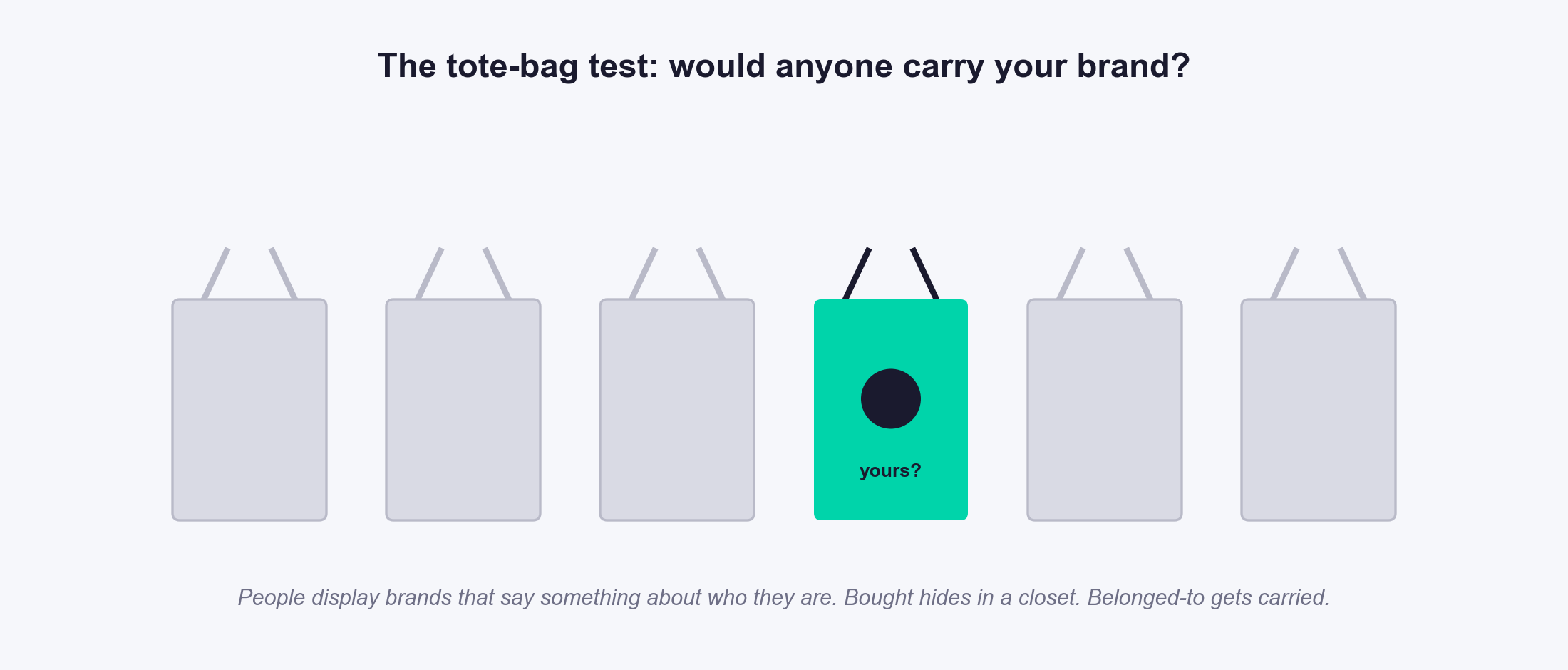
People display brands that say something about who they are. Bought hides in a closet. Belonged-to gets carried.
WORTH CHECKING
Most brands measure loyalty as repeat rate. That’s exactly why our audit scores Advocacy & Referral (Dimension E6) separately from Loyalty & Retention (E5): repeat buyers come back, advocates bring people with them, and the two run on different machinery. If nobody is carrying your brand anywhere, E6 is usually where the score says so. Score your brand: audit.tracebrandbuilding.com.
How CPG brands build belonging without blind boxes
Labubu started with a defined character and a point of view: ugly-cute, a little feral, proudly weird. The mechanics came later, amplifying an identity that already existed. The order matters. Identity first, then expression, then community. Skip the first step and a loyalty program is just a discount with a newsletter.
In practice, belonging for an everyday brand looks unglamorous. One identity, repeated until it’s recognizable without the logo. Rituals members can perform: the way fans order, unbox, stack, refill, or gift the product. And things worth displaying, from packaging designed like an object to merch that signals values rather than advertises to small drops that reward members instead of scalpers. All of it requires knowing exactly who the brand is, because nobody joins a club that can’t describe itself.
The commercial case is the one your CFO will like. Members behave differently, and each behavior has a P&L line. They come back without being re-bought, so retention spend falls. They hold through price increases that send switchers to whatever’s on promo, so realized price improves. And they recruit, so acquisition costs fall as the community grows. Advocacy is the volume promotions can’t buy. In a category where everyone is renting attention one promotion at a time, a brand people belong to is the rare asset on the shelf that compounds.
Hype is a tactic. Belonging is an asset.
The Labubu cycle will complete the way these cycles always do: the crowd moves on, the resale market clears, and commentators declare the fad dead. They’ll be right about the fad and wrong about the lesson. Pop Mart engineered the spike; its fans built the community underneath. One deflates. The other is still there.
Forget the craze. Your brand needs to be joinable: defined enough that shoppers can tell what wearing it would mean, consistent enough that the meaning holds, and confident enough to be carried in public. That’s what turns a product on a shelf into a landmark in its category.
People will line up at dawn for a $30 cup that says who they are. The question for your next planning cycle isn’t how to get them in line. It’s what your brand would say about them if they did.
THE NEXT STEP
You’ve already started running the tote-bag test in your head. Now get a number. Our 29-point brand audit scores the two dimensions this post just walked through: S5 (Category Definition), whether buyers can name the territory you own, and E6 (Advocacy & Referral), whether anyone is recruiting on your behalf. Eight minutes, scored automatically, and you leave with your three weakest dimensions and what to do about them.
FAQ: collectible crazes and brand community
No. Blind-box mechanics run on variable-reward odds and engineered stockouts, which conflict with how repeat-purchase categories work: retailers need forecastable supply, and shoppers need findable products. The transferable part is the identity and membership underneath the gambling.
Signal value. People show brands that say something they want said about themselves, which requires the brand to stand for one specific thing. Generic brands get bought. Defined brands get carried. The tote-bag test above is the fastest way to check which one you are.
Yes, and the proof is already on shelves: totes, water, and tumblers have done it at mass price points. The price of entry is an identity defined enough to join. Most brands fail because the brand never decided who it is. The product was never the problem.

Sources: Pop Mart 2025 results and 2026 outlook; Labubu resale and search-trend reporting (Campaign US); Starbucks Bearista launch (Benzinga); Bearista resale listings (Parade); Lippincott, 12 Trends for 2026 (collectible ephemera); Muniz & O’Guinn, Brand Community, Journal of Consumer Research (2001).