Packaging vs Brand Identity: Which Wins the Second Purchase?
Packaging Buys the First Purchase. Identity Buys the Second.
Gen Z will try a new product for a pack that stops them. Whether they come back is a different question, and the shelf doesn’t answer it.
A shopper slows down in the aisle. Something on the shelf catches their eye: a color, a shape, a piece of type that feels different from everything around it. They pick it up. They turn it over. They drop it in the basket. You just won a trial. Whether you won a customer is the part nobody measures.
Eighty-one percent of Gen Z shoppers say they have tried a product because they liked its packaging (Ad Age / Sonoco). It’s one of the most-cited numbers in consumer goods, and one of the most misread. The second number matters more, and far fewer people quote it: only around 63% went on to buy the product again.
That gap between trying and returning is where mid-tier CPG brands quietly bleed the velocity they fought so hard to win. Trial you paid for. Repeat you didn’t earn. And every point of it compounds against you at the next category review.
(Side note: first impressions are Dimension E1 of our 29-point brand audit. You get about seven seconds at the shelf, and most packs spend them being noticed rather than remembered. Score yours in 8 minutes: audit.tracebrandbuilding.com.)
TL;DR
Packaging is a trial engine: 81% of Gen Z have tried a product because of its packaging. It isn’t a loyalty engine. Only around 63% came back.
The second purchase happens in memory, not in the aisle. It goes to the brand a shopper can recognize and retrieve without thinking.
Below: the research behind that recognition reflex, the three places a pack now has to win, and a five-question test for your next design round.
Packaging is brilliant at trial and powerless at loyalty
On the shelf, a pack has one job: interrupt. Stop the scan, earn the reach, win the trial. Great packaging does this with precision, and the 81% is the reward.
The second purchase happens somewhere a pack can’t reach. It happens in memory: weeks later, in a different aisle or a different tab, when a shopper decides, almost without thinking, to reach for you again. Nothing on the wrapper can force that moment. Something behind the wrapper has to earn it. That something is identity.
The distinction is worth money. You can buy trial with design, displays, and discounts, and the invoice arrives either way. Repeat is the only volume you don’t pay for twice. So when a retail buyer asks why velocity is flat despite strong promotion lift, the honest answer is usually this gap. The brand keeps winning first purchases and losing second ones.
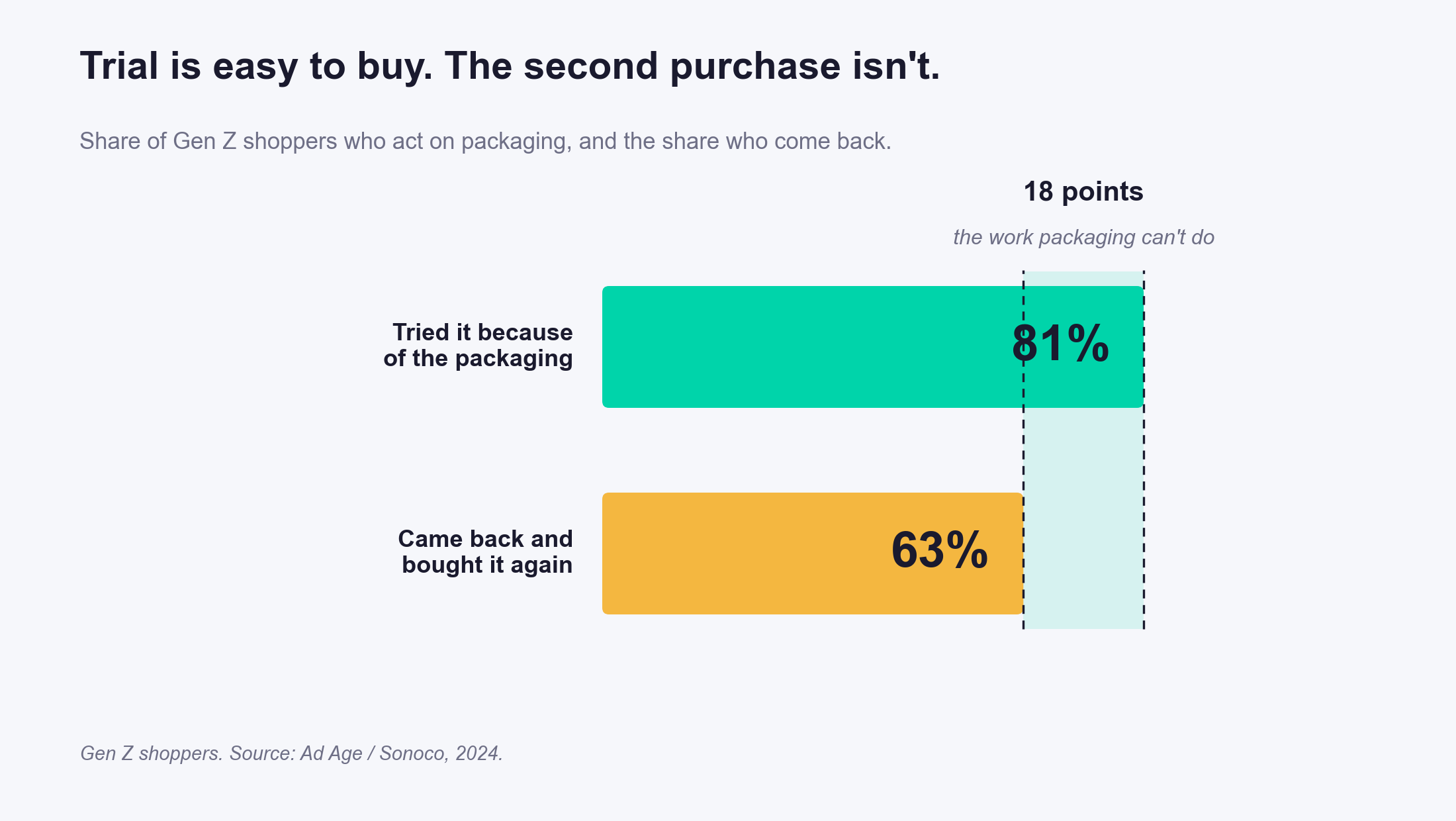
Not all of the 81% who try come back. The gap between trial and repeat is identity’s to close.
Your packaging is your identity’s most-seen sentence
Here’s the reframe. Most teams treat packaging as decoration around a product. Treat it instead as the single most-seen expression of who your brand is: the one line of your brand narrative a shopper reads dozens of times before they ever read your copy, watch your ad, or visit your site.
So the question is never simply “is this pack distinctive?” Distinctive is easy. The real question is distinctive as what. A pack can be striking and still say nothing: loud, on-trend, and interchangeable with the three beside it.
And novelty is getting crowded fast. When every challenger reaches for the same bold-minimal layout and the same expressive type (and generative tools put that look within reach of anyone with a prompt), the trend that was supposed to help you stand out becomes the newest way to blend in. Sameness doesn’t only come from looking boring. It comes from looking like everyone who is trying to look interesting.
Novelty buys the first purchase. Identity earns the refill.
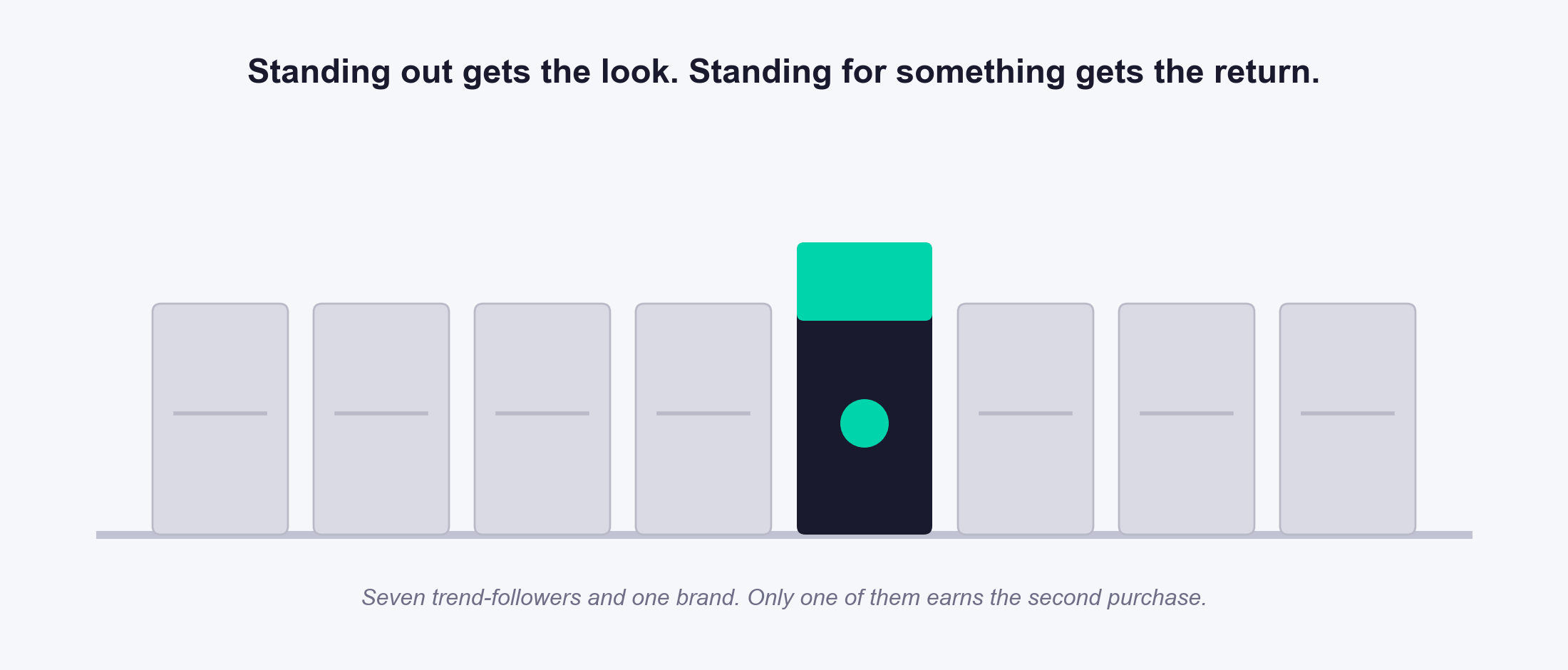
When every pack chases the same trend, the trend becomes the new sameness.
WORTH CHECKING
Worth checking: everything this section just argued, from owning a look to repeating it to resisting the category’s trends, is what Dimension I1 (Visual Identity System) scores in our brand audit. Most teams assume their identity is consistent. Few have ever scored it. Eight minutes, scored automatically. Score your visual identity at audit.tracebrandbuilding.com.
What brand identity does that packaging design can’t
A strong identity turns a pack into a cue. The color you own, the shape of the bottle, the character of the type, the symbol in the corner: each repeats one idea until recognition becomes reflex. The shopper doesn’t study it. They feel it.
This isn’t agency romance; it’s measured behavior. The Ehrenberg-Bass Institute, the marketing-science group behind How Brands Grow, calls these elements distinctive brand assets, and its research is blunt about their job: they build mental availability, the odds that your brand surfaces in a buying moment without prompting. You already run this experiment every week. You can find Heinz on a crowded shelf without reading a word. You’d know Tide’s orange from across the store. That reflex is the asset.
That flicker of recognition is also the difference the 63% are showing you. They’re the shoppers who could find the product again without looking. Two packs with similar design budgets perform differently for exactly this reason. One is a collection of nice decisions. The other is one idea, expressed consistently, never contradicting itself. The first looks good. The second compounds.
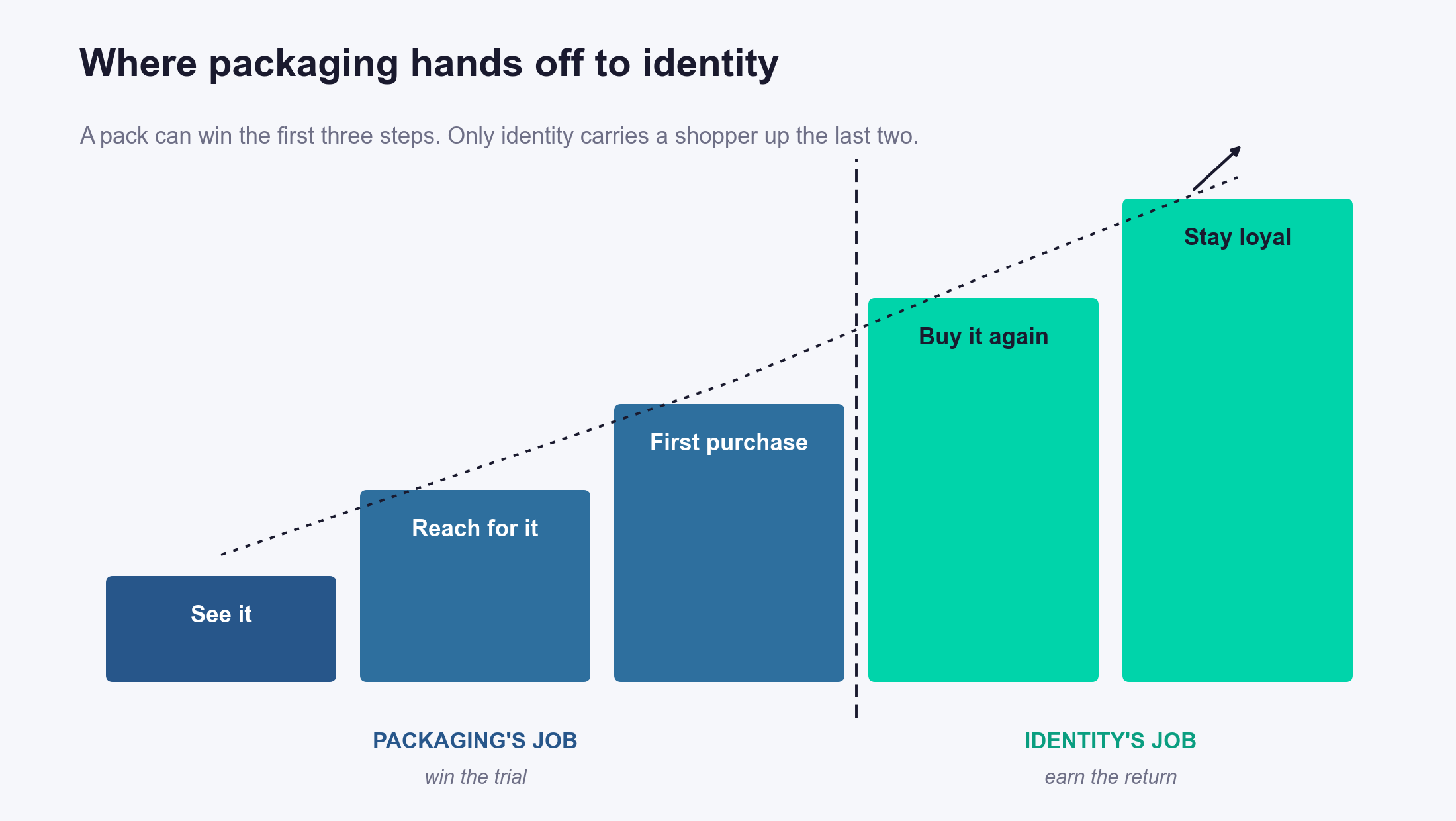
Packaging wins the first three steps. Identity carries the shopper up the last two.
The shelf is only the first of three tests
Modern packaging has to win in three places at once, and most briefs plan for one. It has to hold up on a physical shelf, under hard light, beside its competitors. It has to survive as a thumbnail on a retailer’s site, a few pixels tall, next to forty others. And it has to live as an object on a kitchen counter, where it quietly signals something about the person who chose it.
A pack driven by design alone tends to ace one of those tests and stumble on the others. A pack driven by identity holds together across all three, because the same idea is doing the work each time. Consistency is what gives creativity somewhere to compound.
Five questions to ask your next pack
Before you approve the next design round, hold it up against your identity, not just your category:
- Remove the logo. Would a loyal shopper still know it’s you?
- Does the pack say one thing, or several competing things?
- Does it look like us, or like the category’s idea of “modern”?
- Will it carry its meaning at thumbnail size and on a kitchen counter, away from the shelf?
- A year from now, can it look fresh without starting over?
That last question carries more weight than most teams expect. When a brand changes its look, 87% of consumers form assumptions, and half want the reason explained (Clutch). A pack anchored to a clear identity can evolve without triggering that anxiety. A pack anchored to a trend has to start over every time the trend does.
If the answers are shaky, the problem usually isn’t the design. It’s that there’s no clear identity for the design to express.
Win the second purchase, and velocity takes care of itself
Trial is a spike. Repeat is a trend line. The brands that turn flat velocity into the kind of momentum a board notices are rarely the ones with the most arresting packaging. They are the ones whose packaging says the same true thing, everywhere, until the market stops needing to be reminded.
That is how a label stops competing for attention, starts owning a place in the mind, and becomes the landmark in its category. And for the leader who gets it there, the story changes too: from defending shelf space every quarter to walking into the category review as the brand the buyer wants more of.
Your packaging is already doing the talking. The only question is whether it’s saying something worth coming back for.
THE NEXT STEP
Winning trial but losing the refill is rarely a packaging problem. It’s an identity problem dressed as one. Our 29-point brand audit scores both sides of that line: Dimension E1 (First-Impression Quality) tells you whether your pack is using its seven seconds, and Dimension E3 (Post-Purchase Experience) tells you whether anything is bringing shoppers back for the second one. Eight minutes, scored automatically, no sales pitch, just your three weakest dimensions and what to do about them.
FAQ: packaging and the second purchase
Usually because the first purchase was won by the pack and nothing behind the pack gave them a reason to return. Trial responds to interruption; repeat responds to recognition and a kept promise. If repeat lags trial by a wide margin, audit the identity, not the artwork.
They aren’t rivals. They’re a sequence. Design wins the first purchase, and identity wins every purchase after it. The mistake is briefing the pack as a one-off creative project instead of as the most-seen expression of a defined identity.
Often, yes. The usual fix is subtraction and repetition: fewer competing messages on the pack, and the brand’s ownable elements (color, mark, type) applied without contradiction across every size and channel. The five questions above are the place to start.

Sources: Ad Age / Sonoco (Gen Z packaging trial and repeat-purchase data); Clutch (rebrand perception data); Ehrenberg-Bass Institute (distinctive brand assets and mental availability, per Byron Sharp’s How Brands Grow and Jenni Romaniuk’s Building Distinctive Brand Assets).