Emotional Branding: Why One Feeling Beats Chasing Joy
Stop Trying to Make Shoppers Feel Something. Own One Feeling Instead.
Emotion drives the purchase. That’s exactly why every brand now reaches for the same warm, joyful feeling, and why most of them cancel each other out.
Picture the creative review. Three concepts on the screen, and all three test well. They feel warm. They feel premium. They feel joyful. Your team likes them. The trouble is that the two competitors who share your shelf are down the street, approving concepts that feel exactly the same.
Emotion is doing real work here. PETERMAYER’s Brand Joy Lab, after a year and more than 4,000 respondents, found an 80% correlation between the joy a brand creates and the intent to buy it, with 63% of purchase intent tied to how a brand’s marketing makes people feel. Binet and Field arrived at the same place from a different direction: across 996 campaigns in the IPA Databank, emotionally led work ran close to twice as profitable over the long term as rational persuasion. Feeling is the engine of the purchase.
So everyone floors the same pedal. And when every brand in a category reaches for warmth, warmth stops telling anyone apart. The feeling is real, and it’s forgettable.
(Quick gut check: if the feeling in your last campaign could be lifted out and pasted onto three competitors without anyone blinking, that feeling belongs to the category, not to you. We score it as Dimension S3, Competitive Positioning, in our 29-point brand audit. Score yours in 8 minutes: audit.tracebrandbuilding.com)
TL;DR
Emotion drives the sale: 63% of purchase intent is tied to how a brand makes people feel (PETERMAYER), and emotional campaigns run about twice as profitable over the long term (IPA).
That’s also the trap. When every brand chases the same generic warmth, the feeling stops setting anyone apart. Fewer than one in five brand assets are truly distinctive.
The move is to own one specific emotion competitors can’t credibly claim, then express it the same way in every place a shopper meets you. Below: how to choose it, and a test for your next campaign.
Why “make them feel something” quietly stopped working
The advice to “make them feel something” was useful when half the category still led with features. Today it’s table stakes. Every brand has a mood board, a warmth, a reason to smile. The instruction worked so well that it created the problem it was meant to solve: a category where everyone feels, and everyone feels roughly the same.
Generic positive emotion behaves like a crowded keyword. The more brands bid on “joyful” and “premium” and “feel-good,” the less any single brand earns back for it. You’re paying the category’s going rate for an emotion that does nothing to separate you from it.
A measurement problem hides in here too. When research asks shoppers how a campaign made them feel and they answer “happy,” that lands as a win on the deck. It’s also the exact answer they’d give about your competitor. Positive sentiment is easy to earn and almost impossible to own.
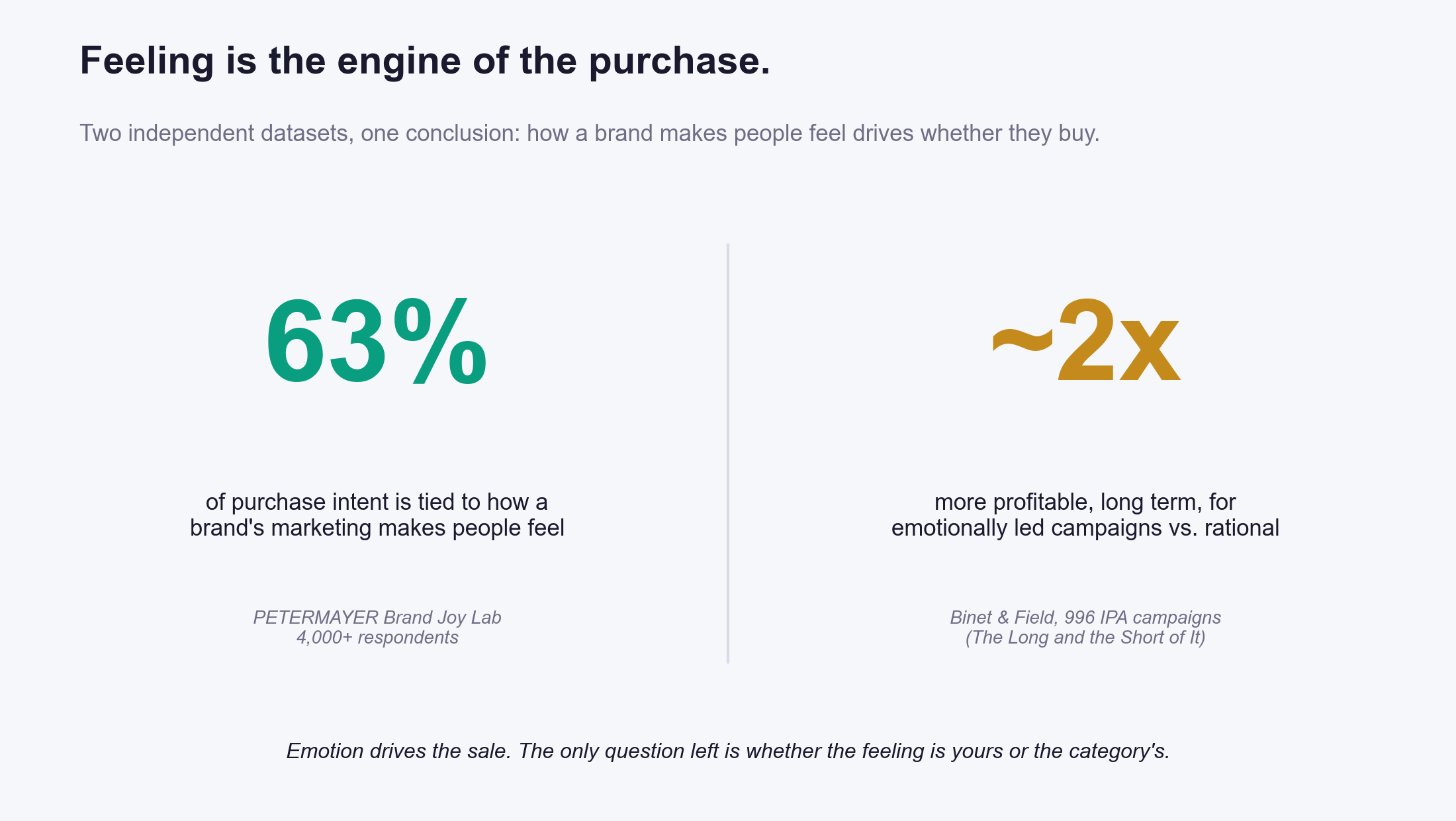
Emotion drives the sale. The only question left is whether the feeling is yours or the category’s.
The sameness trap: everyone is buying the same emotion
Distinctiveness is rarer than most teams assume. A widely cited System1 study found that fewer than one in five brand assets are truly distinctive, the kind that cue one brand and no other. Most brand codes, the emotional ones included, are shared property. The category owns them, not you.
Watch what that does on a shelf. If three yogurts all radiate wholesome family warmth, the warmth doesn’t pull the shopper toward any one of them. It pulls them toward the category, then hands the actual choice to price, placement, or habit. The emotion worked, and it worked for everyone, which means it worked for no one.
This is why “more emotion” is the wrong prescription for a brand that already feels pleasant and forgettable. So the prescription flips. Narrow the feeling instead of amplifying it.
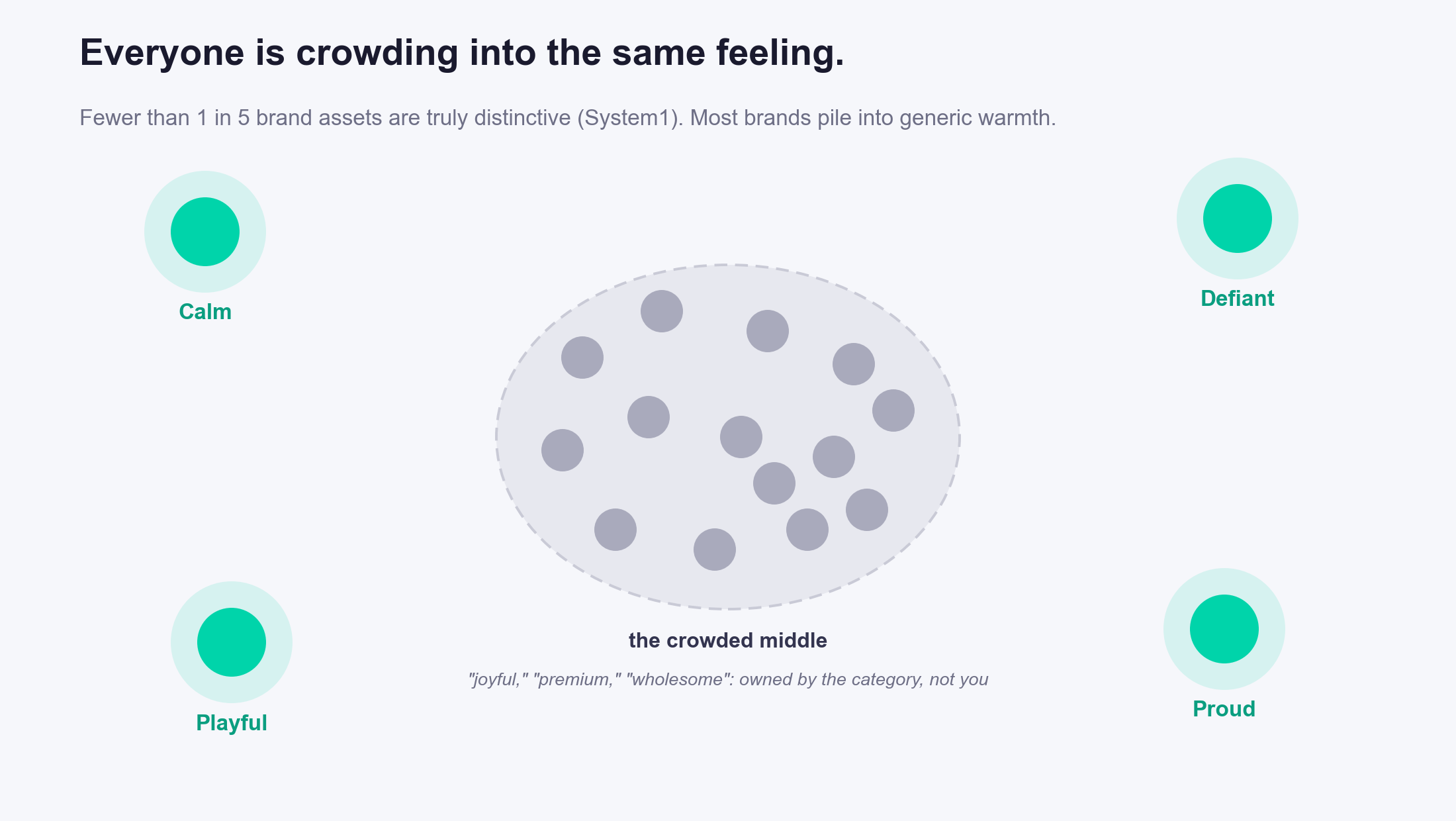
Most brands pile into the same warm middle. The rare ones own a corner no competitor can credibly claim.
Own one feeling: emotional branding that competitors can’t copy
Owning an emotion starts with subtraction. Pick the single feeling you want a shopper to attach to your brand before they can explain why, and accept that choosing one means giving up the rest. A brand that tries to be joyful and reassuring and exciting and wholesome ends up none of them with any conviction.
Three filters make the choice real. The emotion has to be true to what the brand actually is, because shoppers smell a borrowed feeling instantly. It has to be open in the category, a corner competitors have left empty rather than the warm middle everyone is fighting over. And it has to be specific enough to name in one word: not “positive,” but “defiant,” or “calm,” or “mischievous,” or “proud.”
The brands you can picture right now without trying all passed those three. One owns calm. One owns rebellion. One owns childlike delight. None of them owns “good feelings,” because “good feelings” names no territory at all. It’s empty space where a position should be.
Every brand can make you feel good. Almost none can make you feel one thing.
How one feeling compounds across the brand
A chosen emotion is only worth something if it shows up the same way every time a shopper meets you. This is where most emotional strategies quietly die. The deck names a feeling, the launch film delivers it, and then the packaging, the website, the retail media, and the customer email each drift toward their own mood until the brand sounds like five different people who never compared notes.
Consistency is what turns a feeling into a cue. When your color, your voice, your packaging, and your tone all carry the same specific emotion, each exposure deepens the same groove instead of cutting a new one. That’s how recognition becomes reflex, and how a brand builds mental availability, the tendency to surface in a shopper’s mind at the moment of choice. One feeling, repeated without contradiction, becomes the thing a competitor can’t copy by matching your color or your tagline.
This is also the version your CFO can defend. A brand that changes its mood every campaign pays to reintroduce itself each time, because every new feeling restarts the recognition work from zero. A brand that holds one feeling puts the same media behind a memory that is already forming. The budget doesn’t change. The share of it spent re-explaining who you are does.
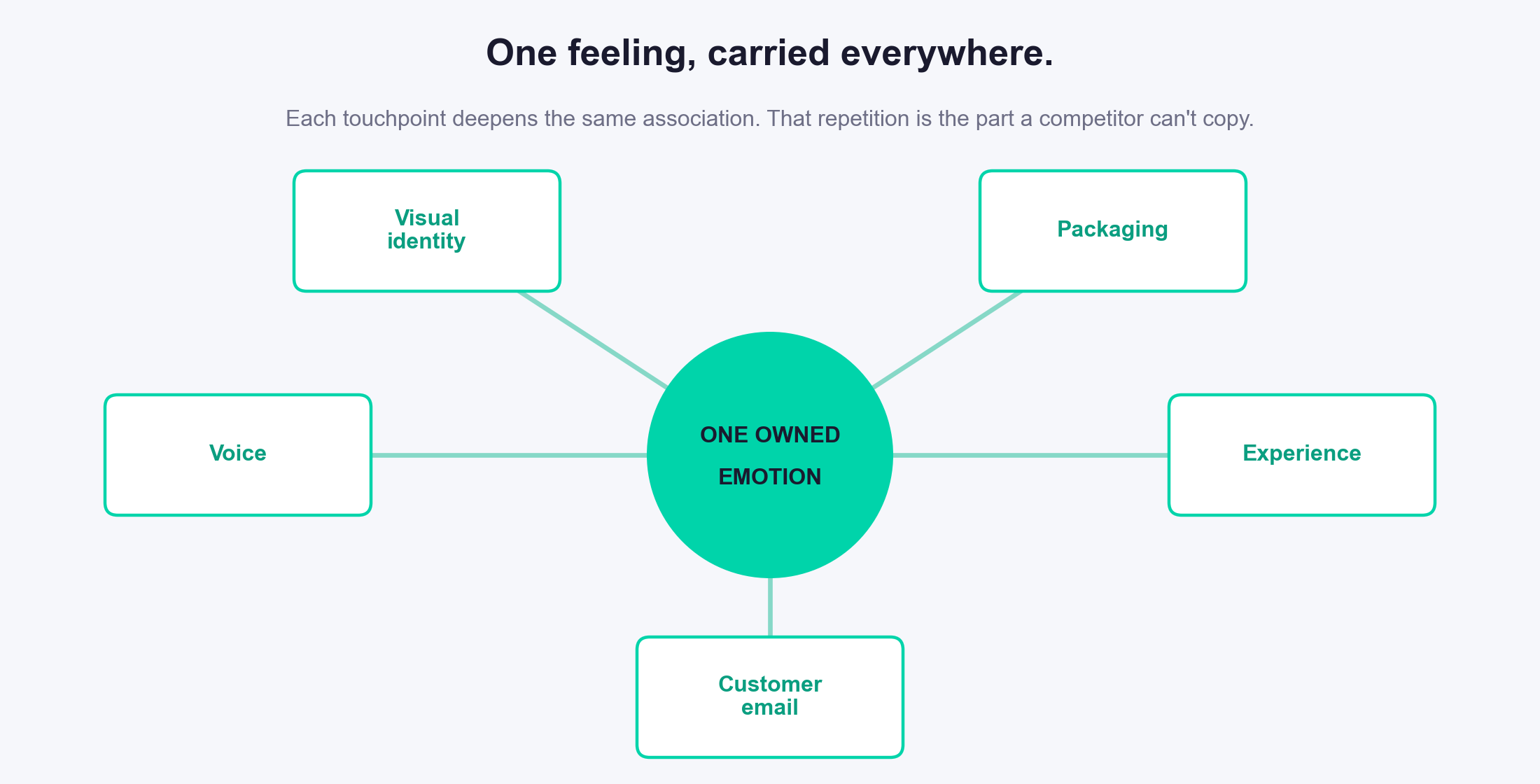
Each touchpoint deepens the same association. That repetition is the part a competitor can’t copy.
WORTH CHECKING
Worth checking: the emotion you choose to own lives or dies in how your brand actually sounds. A distinct feeling, spoken in a voice that could belong to anyone, cancels itself out. That gap between the feeling you intend and the voice that carries it is Dimension I6, Verbal Identity and Voice, and it’s one of the fastest-decaying assets a brand has. Score how your voice lands: audit.tracebrandbuilding.com
A test for your next campaign
Before the next concept gets approved, run it through four questions:
- Name the feeling in one word. If it takes a full sentence, you have a mood, not a position.
- Hand the same brief to your closest competitor. Could they run it unchanged? If yes, you wrote the category’s ad.
- Check the last six touchpoints, from the hero film to the back of the pack. Do they all carry the same emotion, or four different ones?
- Ask whether a loyal shopper would feel the absence if the feeling vanished. If not, the feeling was never doing any work.
If the answers sting, that’s useful. The brands that own an emotion got there by failing these questions first, then fixing what the answers exposed.
Stop trying to be liked. Be unmistakable.
Being liked is a low bar, and a crowded one. Every competent brand in your category is likable, which is exactly why likable no longer moves anyone. The brands that pull shoppers toward them, the ones a whole category gets measured against, win by being impossible to confuse with anyone else. They decided what they make people feel, narrowed it to one thing, and held it until the market couldn’t picture the category without them.
Your next campaign doesn’t need to make shoppers feel more. It needs to make them feel one thing, clearly enough that no one else can claim it. That’s the difference between a brand people like and a landmark they remember.
THE NEXT STEP
You can feel whether your brand owns an emotion or rents the category’s. Getting a number on it is faster. Our 29-point brand audit scores the two dimensions this post walked through: S3 (Competitive Positioning), whether your space is truly yours or shared with three competitors, and I6 (Verbal Identity and Voice), whether your feeling survives contact with how you actually sound. Eight minutes, scored automatically, and you leave with your three weakest dimensions and what to do about them.
FAQ: emotional branding and brand differentiation
It drives sales, and the data isn’t subtle. PETERMAYER’s Brand Joy Lab found 63% of purchase intent tied to how a brand’s marketing makes people feel, and Binet and Field’s analysis of 996 IPA campaigns found emotional campaigns roughly twice as profitable over the long term as rational ones. Emotion is the engine. The mistake is assuming any positive emotion will do.
Because they’re all reaching for the same generic warmth, and emotional codes are mostly shared property. A System1 study found fewer than one in five brand assets are truly distinctive. When every brand cues “wholesome” or “premium,” those feelings point to the category rather than any single brand, so the shopper falls back on price or habit.
Pick one feeling that passes three filters: it’s true to what the brand actually is, it’s unclaimed by competitors, and it’s specific enough to name in a single word. Then express that one emotion consistently across voice, visuals, packaging, and experience, so each touchpoint deepens the same association instead of competing with it.
Sources: PETERMAYER Brand Joy Lab (joy and purchase intent, 4,000+ respondents); Binet & Field, The Long and the Short of It (IPA) (emotional vs rational effectiveness, 996 campaigns); System1 / Marketing Week (share of brand assets that are truly distinctive); Ehrenberg-Bass Institute (distinctive brand assets and mental availability).